Match the Musical Elements to the Art Song in Which They Are Found
Primary Trunk
Chapter 2: Music: Fundamentals and Educational Roots in the U.Southward.
Chapter Summary: The kickoff half of this chapter attempts to ascertain music as a subject and offers perspectives on music, including basic vocabulary and what you lot should know near music in order to contain it in your work with children. The second half gives a brief overview of music education and instruction in the U.South., which provides the foundation of the discipline for the volume.
I. Defining Music
"Music" is one of the most hard terms to define, partially because beliefs about music take changed dramatically over time just in Western civilisation alone. If we look at music in dissimilar parts of the earth, we find even more variations and ideas about what music is. Definitions range from applied and theoretical (the Greeks, for example, defined music equally "tones ordered horizontally equally melodies and vertically every bit harmony") to quite philosophical (co-ordinate to philosopher Jacques Attali, music is a sonoric result between noise and silence, and co-ordinate to Heidegger, music is something in which truth has set itself to work). There are likewise the social aspects of music to consider. Equally musicologist Charles Seeger notes, "Music is a system of communication involving structured sounds produced by members of a customs that communicate with other members" (1992, p.89). Ethnomusicologist John Blacking declares that "we tin can go further to say that music is audio that is humanly patterned or organized" (1973), covering all of the bases with a very wide stroke. Some theorists even believe that there tin can be no universal definition of music because it is so culturally specific.
Although we may find information technology hard to imagine, many cultures, such every bit those found in the countries of Africa or amidst some indigenous groups, don't accept a word for music. Instead, the relationship of music and dance to everyday life is so close that the people take no need to conceptually split up the two. According to the ethnomusicologist Bruno Nettl (2001), some Due north American Indian languages have no discussion for "music" equally distinct from the give-and-take "song." Flute melodies too are labeled every bit "songs." The Hausa people of Nigeria have an extraordinarily rich vocabulary for discourse about music, but no single discussion for music. The Basongye of Zaire have a broad conception of what music is, merely no corresponding term. To the Basongye, music is a purely and specifically human product. For them, when you are content, you sing, and when you are angry, you brand noise (2001). The Kpelle people of Liberia accept 1 word, "sang," to depict a movement that is danced well (Stone, 1998, p. 7). Some cultures favor certain aspects of music. Indian classical music, for example, does not contain harmony, but only the three textures of a melody, rhythm, and a drone. However, Indian musicians more than than make up for a lack of harmony with complex melodies and rhythms non possible in the Due west due to the inclusion of harmony (chord progressions), which require less complex melodies and rhythms.
What nosotros may hear every bit music in the West may not exist music to others. For example, if we hear the Qur'an performed, information technology may audio like singing and music. We hear all of the "parts" which nosotros call up of as music—rhythm, pitch, melody, form, etc. Withal, the Muslim understanding of that audio is that it is actually heightened speech or recitation rather than music, and belongs in a split up category. The philosophical reasoning behind this is complex: in Muslim tradition, the idea of music every bit entertainment is looked upon as degrading; therefore, the holy Qur'an cannot be labeled as music.
Action 2A
Heed
Qur'an Recitation, 22nd Surah (Chapter) of the Qur'an, recited past Mishary Rashid Al-'Efasi of Kuwait.
Although the exact definition of music varies widely even in the West, music contains melody, harmony, rhythm, timbre, pitch, silence, and form or structure. What nosotros know about music and then far…
- Music is comprised of audio.
- Music is made up of both sounds and silences.
- Music is intentionally made art.
- Music is humanly organized sound (Bakan, 2011).
A working definition of music for our purposes might be every bit follows: music is an intentionally organized art grade whose medium is sound and silence, with cadre elements of pitch (tune and harmony), rhythm (meter, tempo, and articulation), dynamics, and the qualities of timbre and texture.
Beyond a standard definition of music, there are behavioral and cultural aspects to consider. As Titon notes in his seminal text Worlds of Music (2008), nosotros "make" music in two different ways: we make music physically; i.e., nosotros bow the strings of a violin, we sing, we press down the keys of a pianoforte, we blow air into a flute. We also make music with our minds, mentally constructing the ideas that nosotros take about music and what we believe about music; i.east., when it should be performed or what music is "skilful" and what music is "bad." For example, the genre of classical music is perceived to have a higher social status than popular music; a rock ring's pb vocalist is more valued than the drummer; early on blues and rock was considered "evil" and negatively influential; nosotros label some songs as children's songs and deem them inappropriate to sing after a sure age; etc.
Music, above all, works in audio and fourth dimension. It is a sonic outcome—a communication just like speech, which requires us to listen, procedure, and reply. To that end, it is a role of a continuum of how we hear all sounds including racket, speech, and silence. Where are the boundaries between noise and music? Between noise and speech? How does some music, such as rap, claiming our original notions of oral communication and music by integrating speech every bit part of the music? How practice some compositions such as John Cage'southward 4'33'' challenge our ideas of artistic intention, music, and silence?
read more than John Cage four'33''
watch this Annenberg Video: Exploring the world of music
Activity 2B
Imagine the audience'south reaction as they feel Cage'due south 4'33" for the starting time time. How might they react after 15 seconds? 30? 1 minute?
Bones Music Elements
- Sound (overtone, timbre, pitch, amplitude, duration)
- Melody
- Harmony
- Rhythm
- Texture
- Structure/class
- Expression (dynamics, tempo, articulation)
In social club to teach something, nosotros need a consensus on a basic list of elements and definitions. This list comprises the basic elements of music as we understand them in Western civilization.
1. Sound
Overtone: A fundamental pitch with resultant pitches sounding above it according to the overtone serial. Overtones are what requite each note its unique audio.
picket this throat-singing
Timbre: The tone color of a sound resulting from the overtones. Each vocalization has a unique tone colour that is described using adjectives or metaphors such as "nasally," "resonant," "vibrant," "strident," "high," "low," "breathy," "piercing," "ringing," "rounded," "warm," "mellow," "nighttime," "bright," "heavy," "light," "vibrato."
Pitch: The frequency of the note's vibration (note names C, D, East, etc.).
Amplitude: How loud or soft a audio is.
Duration: How long or short the sound is.
2. Melody
A succession of musical notes; a serial of pitches often organized into phrases.
3. Harmony
The simultaneous, vertical combination of notes, usually forming chords.
4. Rhythm
The arrangement of music in time. Also closely related to meter.
5. Texture
The density (thickness or thinness) of layers of sounds, melodies, and rhythms in a slice: e.k., a complex orchestral composition will accept more possibilities for dense textures than a song accompanied merely by guitar or piano.
Most common types of texture:
- Monophony: A single layer of sound; e.yard.. a solo voice
- Homophony: A melody with an accompaniment; e.g., a atomic number 82 singer and a band; a vocaliser and a guitar or piano accompaniment; etc.
- Polyphony: Two or more independent voices; eastward.g., a round or fugue.
watch this Musical Texture
6. Structure or Form
The sections or movements of a slice; i.e. verse and refrain, sonata form, ABA, Rondo (ABACADA), theme, and variations.
vii. Expression
Dynamics: Volume (amplitude)—how loud, soft, medium, gradually getting louder or softer (crescendo, decrescendo).
Tempo: Beats per minute; how fast, medium, or slow a piece of music is played or sung.
Articulation: The manner in which notes are played or words pronounced: e.thou., long or curt, stressed or unstressed such every bit brusque (staccato), smooth (legato), stressed (marcato), sudden accent (sforzando), slurred, etc.
What Practice Children Hear? How Do They Respond to Music?
At present that we have a list of definitions, for our purposes, permit'southward refine the definition of music, keeping in mind how children perceive music and music'southward constituent elements of sound (timbre), melody, harmony, rhythm, structure or course, expression, and texture. Children'south musical encounters can exist self- or peer-initiated, or instructor- or staff-initiated in a classroom or daycare setting. Regardless of the type of encounter, the basic music elements play a significant role in how children reply to music. One of the nigh important elements for all humans is the timbre of a sound. Recognizing a sound's timbre is significant to humans in that it helps united states of america to distinguish the source of the sound, i.eastward. who is calling us—our parents, friends, etc. It too alerts united states of america to possible danger. Children are able to discern the timbre of a sound from a very young age, including the vocal timbres of peers, relatives, and teachers, as well equally the timbres of dissimilar instruments.
Studies show that even very immature children are quite sophisticated listeners. Every bit early equally ii years of age, children respond to musical way, tempo, and dynamics, and even testify preference for certain musical styles (e.yard., pop music over classical) beginning at historic period five. Metz and his peers affirm that "a mutual competence found in young children is the enacting through movement of the music'due south most constant and salient features, such as dynamics, meter, and tempo" (Metz, 1989; Gorali-Turel, 1997; Chen-Hafteck, 2004). On the aggregate level, children physically answer to music's crush, and are able to motion more accurately when the tempo of the music more clearly corresponds to the natural tempo of the child. Equally nosotros might expect, children respond to the dynamic levels of loud and soft quite dramatically, changing their movements to friction match changing book levels.
The fact that children seem to respond to the expressive elements of music (dynamics, tempo, etc.) should non come as a surprise. Nearly people respond to the same attributes of music that children do. We hear changes in tempo (fast or irksome), changes in dynamics (loud or soft), nosotros physically respond to the rhythm of the bass guitar or drums, and nosotros heed intently to the melody, particularly if at that place are words. These are among the nearly ear-catching elements, along with rhythm and tune.
This is what we would await. However, there are other studies whose conclusions are more vague on this subject. Co-ordinate to a report by Sims and Cassidy, children's music attitudes and responses do not seem to exist based on specific musical characteristics and children may have very idiosyncratic responses and listening styles (1997). Mainly, children are non-discriminating, reacting positively to almost whatever type of music (Kim, 2007, p. 23).
Activity 2C
What type of music might children all-time respond to given their musical perceptions and inclinations? Is there a particular genre of music, or particular song or ready of songs? How might you get them to respond actively while engaging a high level of cognitive sophistication?
Music Educational activity Vocabulary
After familiarizing yourself with the bones music vocabulary list above (e.g., melody, rhythm), familiarize yourself with a practical instruction vocabulary: in other words, the music terms that yous might use when working in music with a lesson for children that correspond to their natural perception of music. For most children, the basics are easily conveyed through concept dichotomies, such as:
- Fast or Slow (tempo)
- Loud or Soft (dynamics)
- Short or Long (articulation)
- Loftier or Depression (pitch)
- Steady or Uneven (vanquish)
- Happy or Sad (emotional response)
Interestingly, 3 pairs of these dichotomies are institute in Lowell Bricklayer'south Manual for the Boston Academy of Music (1839).
For slightly older children, more than advanced concepts can exist used, such as:
- Duple (two) or Triple (3) meter
- Melodic Contour (tune going up or down)
- Rough or Smooth (timbre)
- Verse and Refrain (class)
- Major or Minor (calibration)
Music Fundamentals
The emotive aspects of music are what almost people respond to first. Still, while an of import function of music listening in our civilisation, just responding subjectively to "how music makes y'all experience" is similar to an Olympic gauge maxim that she feels happy when watching a gymnast'due south vault. Information technology may very well be true, but it does not assist the estimate to sympathise and evaluate all of the elements that go into the execution of the gymnast's do or how to judge it properly. Studies show that teachers who are familiar with music fundamentals, and especially notation reading, are more comfy incorporating music when working with children (Kim, 2007). Fifty-fifty merely knowing how to read music changes a teacher's confidence level when it comes to singing, and then it'due south important to have a few of the basics nether your belt.
Preparation for Learning to Read Music
Formal note reading is not required in order to understand the basics of music. Younger children can learn musical concepts long before learning written notation. Applying some of the vocabulary and concepts from above volition help you begin to discern some of the inner workings of music. The good news is that any type of music tin can be used for practice.
- Melodic Direction. Just beingness able to recognize whether a melody goes upwardly or down is a big pace, and an important auditory-cognitive procedure for children to undergo. Imagine the melody of a vocal such as "Row, Row, Row Your Boat." Sing the song dividing information technology into two phrases (phrase 1 begins with "row," phrase 2 begins with "merrily"). What is the direction of phrase 1? Phrase two? Describe the direction of the phrase in the air with your finger as you sing.
- Timbre. Exercise describing unlike timbres of music—play different types of music on Pandora, for instance, and attempt to draw the timbres you hear, including the vocal timbre of the singer or instrumental timbres.
- Expression. At present practice describing the expressive qualities of a song. Are there dynamics? What type of articulation is at that place? Is the tempo fast, slow, medium?
Learning Note: Pitch
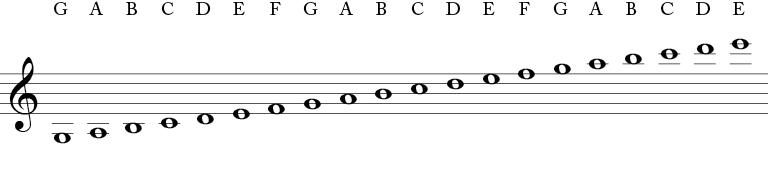
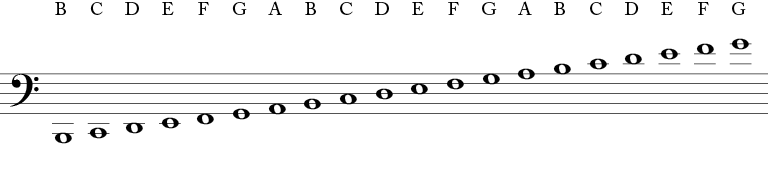
It sounds elementary, but notes or pitches are the edifice blocks of music. Simply being able to read simple notation will help build your confidence. Learning notes on a staff certainly seems dull, but coming up with mnemonics for the notes on the staff tin actually be fun. For example, most people are familiar with:
- Every Good Male child Deserves Fudge to indicate the treble clef line notes
- F A C E to betoken the treble clef space notes
- Good Boys Deserve Fudge Always for the bass clef line notes
- All Cows Eat Grass for the bass clef infinite notes
- Just allowing children to develop their ain mnemonic device for these notes can a artistic mode to have them own the notes themselves. How near Grizzly Bears Don't Wing Airplanes for the lines of the bass clef, or Empty Garbage Before Dad Flips or Elephants Become Big Dirty Anxiety for the lines of the treble clef?
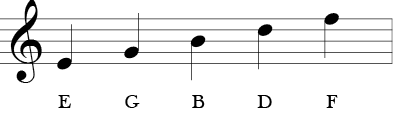
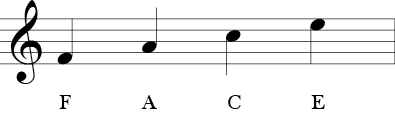
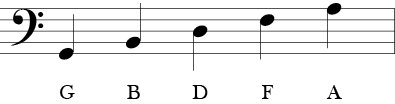
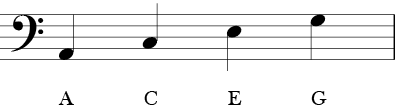
Notes of the Treble Staff
Notes of the Bass Staff
Note/Pitch Proper noun Practice
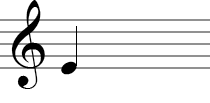
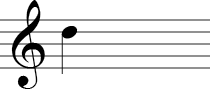
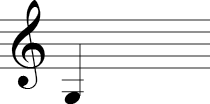
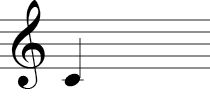
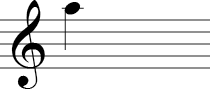
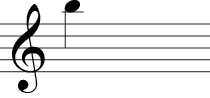
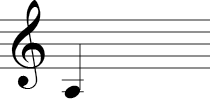
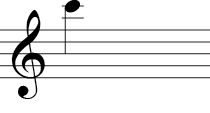
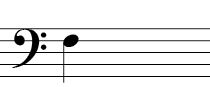
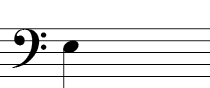
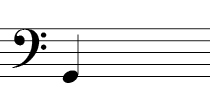
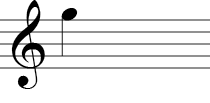
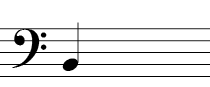
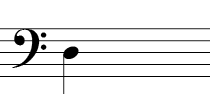
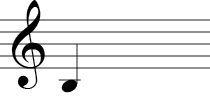
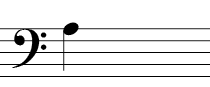
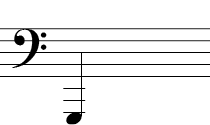
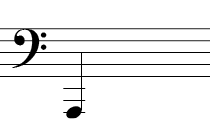
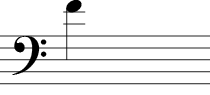
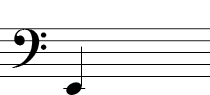
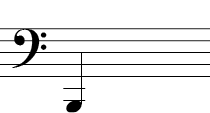
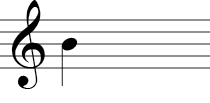
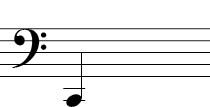
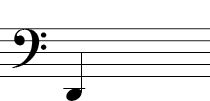
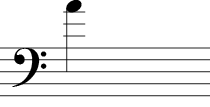
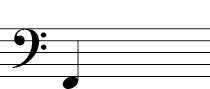
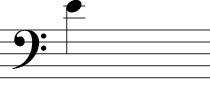
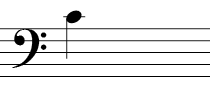
Notation Review: Spelling Words with Notation names
Learning Annotation: Rhythm
Rhythm concerns the organization of musical elements into sounds and silences. Rhythm occurs in a melody, in the accompaniment, and uses combinations of short and long durations to create patterns and entire compositions. Rests are equally important to the music as are the sounded rhythms because, but like linguistic communication, rests use silence to assist organize the sounds so nosotros tin better sympathise them.
Notes and rests
| Whole notation | Whole rest |
| Dotted half annotation | Dotted half rest |
| Half note | Half rest |
| Quarter note | Quarter balance |
| Eighth notation | Eighth rest |
| Sixteenth annotation | Sixteenth rest |


Rhythm Practice: Label each rhythm
Learning Notation: Meter
Meter concerns the organization of music into stiff and weak beats that are separated by measures. Having children feel the strong beats such as the downbeat, the first beat in a measure, is relatively easy. From at that place, it's a matter of counting, hearing and feeling how the strong vs. weak beats are grouped to create a meter.
Duple Meters
In duple meter, each mensurate contains groupings of two beats (or multiples of two). For example, in a two/4 fourth dimension signature, there are two beats in a measure with the quarter note receiving one beat or 1 count. In a iv/4 time signature, at that place are 4 beats in a mensurate, and the quarter notation as well receives 1 beat or count.

Examples of two/4 Rhythms









Examples of 4/four Rhythms








Triple Meters
In triple meter, each measure contains iii beats (or a multiple of three). For instance, in a 3/4 time signature, there are three beats in a measure out and the quarter note receives i beat.

Examples of 3/iv Rhythms









Compound Meters
Both duple and triple meter are known equally simple meters—that means that each beat out can be divided into two eighth notes. The time signature six/8 is very mutual for children's rhymes and songs. In 6/8, there are half dozen beats in a measure with each 8th note receiving one beat. 6/viii is known as a compound meter, meaning that each of the two main beats can be divided into iii parts.

Examples of vi/8 Rhythms






Learning Notation: Dynamics
Learning basic concepts such as dynamics and tempo volition amend equip you to involve children in more nuanced music making and listening.
The two basic dynamic indications in music are:
- p, for piano, meaning "soft"
- f, for forte, significant "loud" or actually, with force, in Italian
More subtle degrees of loudness or softness are indicated by:
- mp, for mezzo-piano, meaning "moderately soft"
- mf, for mezzo-forte, meaning "moderately loud"
There are also more extreme degrees of dynamics represented by:
- pp, for pianissimo and meaning "very soft"
- ff, for fortissimo and meaning "very loud"
Terms for changing volume are:
- Crescendo (gradually increasing volume)
- Decrescendo (gradually decreasing book)

Crescendo

Decrescendo
Dynamics Practice
Fill in the blanks below using the post-obit terms: fortissimo, pianissimo, mezzo-forte, mezzo-pianoforte, crescendo, decrescendo, forte, piano
| 1. p | |
| 2. f | |
| 3. ff | |
| 4. mp | |
| v. | |
| half-dozen. mf | |
| 7. pp | |
| 8. |


Learning Note: Tempo
Tempo is the speed of the music, or the number of beats per infinitesimal. Music's tempo is rather infectious, and children respond physically to both fast and slow speeds. The following are some terms and their beats per infinitesimal to assistance y'all gauge different tempi. The terms are in Italian, and are listed from slowest to fastest.
- Larghissimo: very, very slowly (nineteen beats per minute or less)
- Grave: slowly and solemnly (20–twoscore bpm)
- Lento: slowly (xl–45 bpm)
- Largo: broadly (45–50 bpm)
- Larghetto: rather broadly (50–55 bpm)
- Adagio: slow and stately (literally, "at ease") (55–65 bpm)
- Andante: at a walking footstep (the verb andare in Italian ways to walk) (73–77 bpm)
- Andantino: slightly faster than andante (78–83 bpm)
- Marcia moderato: moderately, in the style of a march (83–85 bpm)
- Moderato: moderately (86–97 bpm)
- Allegretto: moderately fast (98–109 bpm)
- Allegro: fast, quickly and bright (109–132 bpm)
- Vivace: lively and fast (132–140 bpm)
- Allegrissimo: very fast (150–167 bpm)
- Presto: extremely fast (168–177 bpm)
- Prestissimo: even faster than presto (178 bpm and above)
Terms that refer to changing tempo:
- Ritardando: gradually slowing downward
- Accelerando: gradually accelerating
Action 2d
Exploring tempo in everyday life: The average person walks at a stride betwixt 76-108 beats per minute. Playlists can offer unlike tempi for different types of exercise. Detect your tempo! What song fits a dull walking speed, medium, brisk, running? Stores play songs in slower tempi to encourage you to shop. Go to a supermarket or store and notice your walking speed. Is information technology connected to the crush of the music?
Read More How Stores use Music
Scales
Scales are sets of musical notes organized by pitch. In Western culture, we predominantly use the major and minor scales. Even so, many children'due south songs use the pentatonic scales (both major and minor) as well.
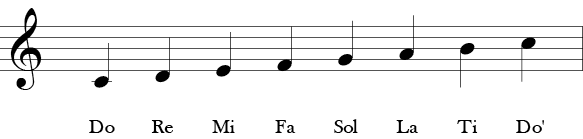
The major calibration comprises 7 different pitches that are organized past using a combination of one-half steps (one note on the piano to the very adjacent notation) and whole steps (two one-half steps together). The major scale looks equally follows: Whole Whole Half Whole Whole Whole One-half or Westward Westward H W W W H.
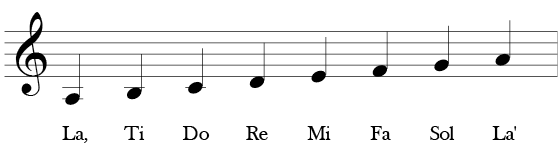
A small-scale calibration uses the post-obit formula: W H W W H W Due west.
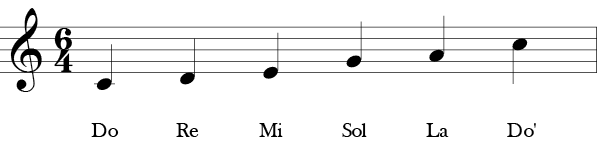
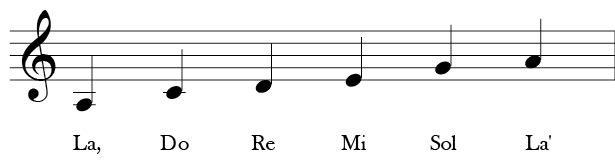
Pentatonic scales, found in many early American and children's songs, but apply five pitches, hence the moniker "pentatonic." There are many types of major pentatonic scales, only one of the about popular major pentatonic scale is similar to the major scale, but without the 4th or seventh pitches (Fa or Ti). One of the common minor pentatonic scales is similar to the pocket-size scale, but too without (Fa or Ti).
Major, pocket-size (natural), and pentatonic scales
Major Scale (C Major)
Minor Calibration (A Small)
Major Pentatonic (C)
Pocket-sized Pentatonic (A)
Scale Do
Characterization the one-half steps and whole steps for the C major calibration.

Practice writing your own C major scale.

Label the one-half steps and whole steps of the A small calibration.

Practice writing your own A pocket-sized scale.
Resources for Farther Learning
At that place are numerous websites that cover the fundamentals of music, including the staff, notes, clefs, ledger lines, rhythm, meter, scales, chords, and chord progressions.
Music Theory
www.musictheory.net
musictheory.net is a music theory resources from basic to complex. Information technology contains active definitions for musical terms; music lessons regarding the meanings of musical notation; and exercises designed to farther understanding of musical notes, chords, and many other musical aspects. This site besides includes a pop-up pianoforte and accidental calculator specifically to help users larn and practise their developing musical skills. It also features a products page with apps people tin can buy to practise and apply music on the go via their smartphones. The site would be appropriate for people ages 12 and upwards, and is extremely user friendly.
http://www.musictheoryvideos.com/
Musictheoryvideos.com was designed by Stephen Wiles in the hope to brand music theory an active role of music learning. The site includes music theory lessons for students between grades 1 and five in the grade of tables, lists, and videos to help the student meliorate understand the many parts of music. In that location are videos about the importance and departure of treble and bass clefs; in that location is a list of music terms and what they hateful, and the site fifty-fifty contains videos entailing the transposition of music. Information technology would be a bully resource for teachers to offering students, peculiarly those who could benefit from some extra information outside of course. The site contains data that would have a educatee step by footstep through the nuts of music theory through simple short videos, complete with British-accented narrations.
https://www.themightymaestro.
The Mighty Maestro website contains interactive games for children kickoff with note values and pitches. Unfortunately, some of the activities require payment, but the free access games are very basic in terms of musical skill and literacy level, and very accessible.
https://www.classicsforkids.
Classics for Kids is an splendid website with a wealth of music information geared for children. Games, online listening, quizzes, activity sheets, data on composers, and lots of music history brand this website highly valuable. The website is user friendly, bright, and cheerful, and very easy to navigate. Information technology as well contains sections for parents and teachers.
www.mymusictheory.com
Mymusictheory.com includes helpful lessons for students grades 1 through six, equally well as helpful links for teachers when information technology comes to instruction music theory. For the teachers, they provide music flashcards, lesson plans, music-reinforcing word searches, and many other helpful resources, all in one location. The site is broken down by course level, with each level containing exercises and practice exams for the fabric learned during each lesson.
world wide web.8notes.com
8notes.com is a large website full of music lessons for several instruments, including but not limited to piano, guitar, song, and percussion. Gratis sheet music is bachelor for the unlike instruments, as well as music from different popular movies. An online metronome, guitar tuner, blank canvass music, music theory lessons, and music converters are all bachelor at 8notes.com. This site would be helpful to those learning new instruments, besides equally experienced musicians who are only looking for some new music to play.
Note Reading
- http://readsheetmusic.info/alphabetize.shtml
- https://www.teoria.com/
- https://www.classicsforkids.com/games/note_names.php
Keyboard Skills
Many classroom teachers take pianos in their rooms and don't know how to use them or underutilize them. Learning to play a basic tune on a piano or keyboard or fifty-fifty put a few chords to them is a great conviction builder, and the children love to sing to a pianoforte accompaniment!
- http://www.howtoplaypiano.ca/
- http://world wide web.pianobychords.com/
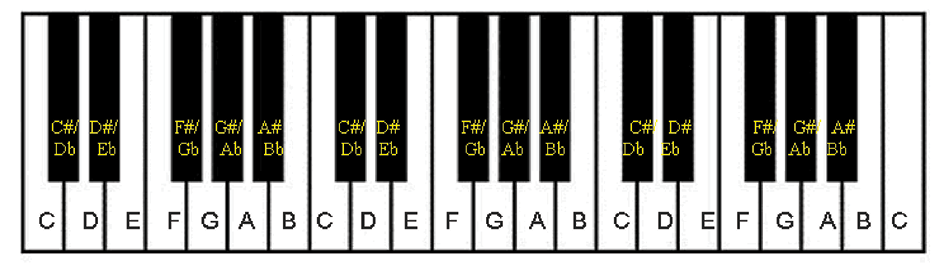
Notes on a keyboard
2. Music Education in America
Music pedagogy does non exist isolated in the music classroom. It is influenced by trends in full general teaching, society, civilization, and politics.
—Harold Abeles, Critical Issues in Music Educational activity, 2010
How did music educational activity develop into its electric current form? Did music specialists e'er teach music? What were classroom instructor's musical responsibilities? Well, to answer these questions, we need to look to the past for a moment. Initially, music and education worked hand in hand for centuries.
Early Music Teaching
18th century: Singing schools and their melody books
Earlier in that location was formal music pedagogy in the United states, at that place was music and didactics, primarily experienced through religious didactics. Music education in the U.Southward. began after the Pilgrims and Puritans arrived, when ministers realized that their congregation needed help singing and reading music. Several ministers developed melody books that used four notes of solfege (Mi, Fa, Sol, La) and shape notes to train people in singing the psalms and hymns required for proper church singing. By 1830, singing schools based on the techniques found in these books began popping up all over New England, with some people attending singing school classes every day (Keene, 1982). They were promised that they would learn to sing in a month or become music teachers themselves in three months.
Some consider the hymn music of this time to exist uniquely American—borrowing styles from Ireland, England, and Europe, but using trip the light fantastic toe rhythms, loose harmonic rules, and circuitous song parts (counterpoint) where each vocalization (soprano, alto, tenor and bass) sang its own unique tune and no one had the master tune. Original American composers such every bit William Billings wrote hundreds of hymns in this style.
19th century
Johann H. Pestalozzi (1746–1827)
Pestalozzi was an educational reformer and Swiss philosopher born in 1746. He is known as the male parent of modern instruction. Although his philosophies are over 200 years onetime, y'all may recognize his ideas as sounding quite contemporary. He believed in a kid-centered educational activity that promoted understanding the world from the child'due south level, taking into account individual development and concrete, tactile experiences such as working directly with plants, minerals for science, etc. He advocated educational activity poor equally well equally rich children, breaking down a subject to its elements, and a broad, liberal education along with teacher grooming. In the U.S., normal schools would take off by the end of the 19th century, and advocates of Pestalozzi's educational reform would put into place a organization of teacher training that influences us to this day.
Lowell Mason (1792–1872) and the "Ameliorate Music" motility
Lowell Bricklayer, considered the founder of music education in America, was a proponent of Pestalozzi's ideas, particularly the rote method of education music, where songs were experienced and repeated first and concepts were taught afterward. Mason authored the first series volume based on the rote method in 1864 called The Song Garden.
Bricklayer was highly critical of both the singing schools of the day and the compositional manner. He was horrified at the promises that singing schools fabricated to their students—namely that they could be qualified to teach later but a few months of lessons, and the general limerick techniques used at the fourth dimension. Mason felt that the music, including the work of composers such as Billings, was "rude and crude." To change this, he promoted simplified harmonies that made the tune the about prominent aspect of the music, and downgraded the importance of the other vocal parts to support the tune. He accomplished this through the establishment of shape note singing schools, which carried out his musical vision. The result was that the original hymn mode became the purview of the shape annotation singing schools, mostly in the South, where they flourished for many years. The virtually famous shape-notation book is chosen Sacred Harp.
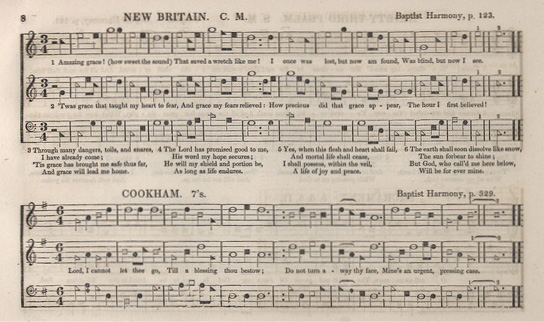
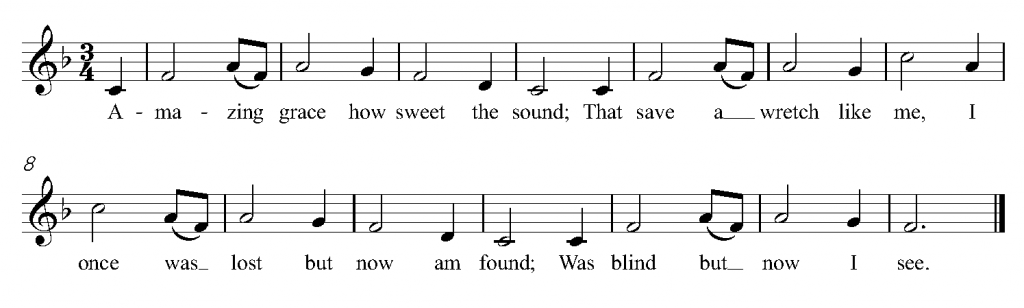
Under the title "New Britain", "Amazing Grace" appears in a 1847 publication of Southern Harmony in shape notes
The songs in Sacred Harp were religious hymns. "Amazing Grace" was ane of the songs published in this book.
Amazing Grace
John Newton (1779), Sacred Harp Songbook (1844)
watch this Shape Note Singing
watch this Sacred Harp Shape Note Singing
read more Shape Notes
In 1833, Lowell Mason and others began to introduce the thought of music teaching in the schools. Bricklayer, along with Thomas Hastings, went on to establish the first public school music program in Boston, beginning with the Boston Singing School, which taught children singing nether his methodology. Eventually, regular classroom teachers were educated in normal schools (later called teachers' colleges), developed in the mid-19th century, where they were taught the general subjects and were expected to teach the arts as well (Brown, 1919).
The up-to-engagement primary school, realizing the limitations of the three R's curriculum, has enriched its program by adding such activities equally singing, drawing, constructive occupations, story-telling, and games, and has endeavored to organize its work in terms of children rather than the subject matter (Temple, 1920, 499).
Music and the normal school
Normal schools in the 19th century grew out of a need to brainwash a burgeoning young American population. These schools were instructor grooming courses, usually with access to model schools where teachers in training could notice and exercise teach. Music was a pregnant part of educational activity. The Missouri Land Normal School at Warrensburg stressed the importance of music in their catalog from 1873–74:
Vocal Music—the importance of music every bit 1 of the branches of didactics is fully recognized. Vocal music is taught throughout the entire grade…and teachers are advised to go far a function of the class of instruction in every school with which they may exist continued (Keene, 1982, p. 204).
Music and educational activity in America: 20th century
Music supervisors, who oversaw the work of classroom teachers, received additional training in music. Music education in the early on 20th century connected under the purview of the music supervisor, while classroom teachers were trained to teach music to their students. Gradually, a specialization process began to occur and music became a regular field of study with its own certification, an educational tradition that continues to this mean solar day. Past the 1920s, institutions in the U.S. began granting degrees in music education and, along with groups such every bit the Music Supervisor'southward Briefing (later the Music Educator's National Conference and currently the National Association for Music Educators or NAfME), supported the utilise of qualified music teachers in the schools. Eventually, the arts broke into dissimilar specialties, and the split role of music teacher every bit we know it was created.
Ironically, there was groovy business at the time regarding these special music teachers. Because music was no longer in the easily of the classroom teachers, keen effort was made to "bring music in every bit close a relation to the other piece of work as is possible under the present arrangement of a special music teacher" (Goodrich, 1901, p. 133).
Contemporary Music Education
Instructional methods
The function of music in the U.S. educational system is perpetually under word. On one mitt, many run into structural problems inherent in music's connection to its history and the glaring distinction between the prevalence, importance, and function of music's office in everyday life and its embattled role in the classroom Sloboda (2001). On the other, increased advocacy is required in order to justify music'southward existence and terms of benefits to the kid amidst the threat of constant budget cuts. Given this, information technology is important to call up music pedagogy'south history, origin and deep roots in the American education experience.
The beginning of the 20th century was an exciting time for music pedagogy, with several significant instructional methods beingness developed and taking hold. In the Usa, music education adult around a method of instruction, the Normal Music Form, the remnants of which are adhered to even today in music classrooms. The books used a "graded" curriculum with successively more complex songs and exercises, and combined author-composed songs in these books with folk and classical material. An online copy of the New Normal Music Course (1911) for fourth and 5th graders is attainable via Google Books.
In Europe and Asia, four outstanding and very unlike music instruction methods developed: the Kodály Method, Orff Schulwerk, Suzuki, and Dalcroze all played significant roles in furthering music education abroad and in the U.South., and were methods based on folk and classical genres (see Chapter four for further discussion about these methods). In contrast to the early music books for the Normal School, for which there was "a paucity of song textile prompting the authors of the original class to chiefly use their own vocal material" (Tufts & Holt, 1911, p. 3), Kodály and Orff in particular used authentic music in their methods, and authentic music directly related to children's lives (see Chapter 4 for more on this).
Resources
Gregory, A., Worrall, L., & Sarge, A. (1996). The development of emotional responses to music in young children. Motivation and Emotion. December twenty (four), 341–348.
Boone, R., & Cunningham, J. (2001). Children'due south expression of emotional pregnant in music through expressive body movement Periodical of Non-verbal Beliefs. March, 25 (1), 21–41.
- Children every bit young as four and 5 years old were able to portray emotional meaning in music through expressive movement.
Metz, E. R. (1989). Movement as a musical response amongst preschool children. Journal of Research in Music Instruction 37, 48–sixty.
- The principal result of "Movement as a Musical Response Amidst Preschool Children" was the generation of a substantive theory of children's movement responses to music. The writer as well derived implications of the seven propositions of early children education and move responses to music.
Sims, W., & Cassidy, J. (1997). Exact and operant responses of young children to vocal versus instrumental song performances. Periodical of Research in Music Education, 45(2), 234–244.
- Young children'south music attitudes and responses do not seem to be based on specific musical characteristics; children may have very idiosyncratic responses and listening styles.
References
Abeles, H. (2010). The historical contexts of music education. In H. Abeles & L. Custodero (Eds.), Disquisitional issues in music educational activity: Contemporary theory and exercise (1–22). Oxford, UK: Oxford University Press.
Abeles, H., and Custodero, L. (2010). Disquisitional issues in music education: Contemporary theory and practice. Oxford, United kingdom: Oxford University Press.
Andress, B. (1991). From research to practice: Preschool children and their movement responses to music. Young Children, November, 22–27.
Atkinson, P., & Hammerley, M. (1994). Ethnography and participant observation. In N. K. Denzin & Y. S. Lincoln (Eds.), Handbook of qualitative research (248–261), M Oaks, CA: Sage Publications.
Attali, J. (1985). Dissonance: The Political Economy of Music. Minneapolis: University of Minnesota Press.
Bakan, K. (2011). World music: Traditions and transformations. New York: McGraw-Hill.
Blacking, J. (1973). How Musical is Man? Seattle: University of Washington Press.
Boone, R. T., & Cunningham, J. G. (2001). Children's expression of emotional pregnant in music through expressive body movement. Periodical of Nonverbal Behavior v(1), 21–41.
Bresler, 50., & Stake, R. E. (1992). Qualitative research methodology in music education. In R. Colwell (Ed.), Handbook of research on music teaching and learning (75–90). New York: Schirmer Books.
Brown, H. A. (1919). The Normal Schoolhouse curriculum. The Uncomplicated School Journal 20(4), nineteen, 276–284.
Chen-Hafteck, L. (2004). Music and motion from zero to three: A window to children's musicality. In 50. A. Custodero (Ed.), ISME Early Childhood Commission Conference—Els Móns Musicals dels Infants (The Musical Worlds of Children), July 5–10. Escola Superior de Musica de Catalunya, Barcelona, Spain. International Order of Music Education.
Cohen, V. (1980). The emergence of musical gestures in kindergarten children (Unpublished doctoral dissertation). Academy of Illinois, Champaign, IL.
Flohr, J. W. (2005). The musical lives of young children. Upper Saddle River, NJ: Pearson Prentice-Hall Music Educational activity Series.
Goodrich, H. (1901). Music. The Elementary School Teacher and Class of Study, ii(2), 132–33.
Graue, M. E., & Walsh, D. J. (1998). Studying children in context: Theories, methods and ethics. M Oaks, CA: Sage Publications.
Heidegger, Martin. (2008). On the Origin of the Work of Art. In D. Farrell Krell (Ed.) Bones Writings (143-212). New York: Harper Collins
Holgersen, S. E., & Fink-Jensen, K. (2002). "The lived trunk—object and subject in research of music activities with preschool children." Paper presented at the meeting of the10th International Briefing of the Early Babyhood Commission of the International Order for Music Instruction, August 5–9, Copenhagen, Denmark.
Janesick, V. J. (1994). The dance of qualitative enquiry design: Metaphor, methodology, and meaning. In Due north. Yard. Denzin & Y. S. Lincoln (Eds.), Handbook of qualitative inquiry (209–219). Thousand Oaks, CA: Sage Publications.
Hashemite kingdom of jordan-DeCarbo, J., & Nelson, J. A. (2002). Music and early babyhood education. In R. Colwell & C. Richardson (Eds.), The new handbook of inquiry on music teaching and learning (210–242). Oxford, Britain: Oxford Academy Press.
Keene, J. (1982). History of music instruction in the United states of america. Hanover, NH: University Printing of New England.
Kim, H. K. (2007). Early childhood preservice teachers' behavior about music, developmentally appropriate exercise, and the relationship between music and developmentally appropriate do (Unpublished doctoral dissertation). University of Florida, Gainesville, FL.
Bricklayer, L. (1839). Manuel of the Boston Academy of Music for the instruction of vocal music in the arrangement of Pestalozzi. Boston, MA: Wilkins and Carter.
Bricklayer, L. (1866). The song garden. Boston, MA: Oliver Ditson and Co.
Metz, Due east. (1989). Motion as a musical response among preschool children. Periodical of Research in Music Educational activity 37(ane), 48–60.
Moog, H. (1976). The musical feel of the pre-schoolchild. (C. Clarke, Trans.). London: Schott Music. (Original piece of work published 1968)
Moorhead, G. Due east., & Pond, D. (1978). Music of young children: General observations. In Music of Young Children (29–64). Santa Barbara, California: Pillsbury Foundation for Advancement of Music Education. (Original piece of work published 1942)
Nettl, B. (2001). Music. In S. Sadie (Ed.), New Grove dictionary of music and musicians (Vol. 17, 425-37) London: Grove'south Dictionaries of Music Inc.
Peery, J. C., & Peery, I. W. (1986). Effects of exposure to classical music on the musical preferences of pre-schoolhouse children. Periodical of Enquiry in Music Education 33(1), 24–33.
Retra, J. (2005). Musical movement responses in early childhood music education practice in the Netherlands. Paper presented at the meeting of Music Educators and Researchers of Young Children (MERYC) Conference, April 4–v, at the University of Exeter.
Sims, Westward. Fifty. (1987). The use of videotape in conjunction with systematic observation of children's overt, concrete responses to music: A research model for early on childhood music education. ISME Yearbook 14, 63–67.
Sims, W. L., & Nolker, D. B. (2002). Individual differences in music listening responses of kindergarten children. Journal of Research in Music Education l(two), 292–300.
Singing Schools. (n.d.). Library of Congress. https://www.loc.gov/collections/music-of-nineteenth-century-ohio/articles-and-essays/singing-schools/ (accessed June 24, 2021).
Sloboda, J. (2001). Emotion, functionality and the everyday experience of music: Where does music educational activity fit? Music Instruction Research 3(ii).
Smithrim, Grand. (1994). Preschool children's responses to music on television set. Newspaper presented at the International Society for Music Education Early Childhood Commission Seminar "Vital Connections: Young Children, Adults & Music," July 11–15, University of Missouri-Columbia.
Rock, R. (1998). Africa, the Garland encyclopedia of globe music. New York: Garland Publishing, Inc..
Temple, A. (1920). The kindergarten chief unit of measurement. The Unproblematic School Periodical, 20/vii(20), 498–509.
Titon, J. T. (2008). Worlds of music: An introduction to the music of the world's people. Boston, MA: Cengage.
Tobin, J. J., Wu, D. Y. H., & Davidson, D. H. (1989). Preschool in three cultures—Nippon, China, and the United States. New Haven and London: Yale University Press.
Tufts, J., and Holt, H. (1911). The New Normal music form. Need location of publisher: Silver Burdett and Co.
Vocabulary
joint: the manner in which notes are played or words pronounced; e.g., long or short, stressed or unstressed
counterpoint: the art of combining melodies
dynamics: indicates the volume of the sound, and the changes in volume (e.g. loudness, softness, crescendo, decrescendo).
harmony: the simultaneous combination of tones, particularly when blended into chords pleasing to the ear; chordal construction, as distinguished from melody and rhythm
homophony: a melody with an accessory; due east.g., a atomic number 82 singer and a band
indigenous groups: people associated with a certain area who codify their own culture
melody: musical sounds in agreeable succession or organization
meter: the organization of strong and weak beats; unit of measurement of measurement in terms of number of beats in a measure out
monophony: single layer or sound; due east.m.; a soloist
notation: how notes are written on the page
pitch: the frequency of a annotation's vibration
polyphony: two or more than independent voices; e.thousand., a round of a fugue
psalms and hymns: examples of church music
recitation: reading a text using heightened oral communication, similar to chanting
rhythm: the pattern of regular or irregular pulses caused in music by the occurrences of potent or weak melodic and harmonic beats
rote method: memorization technique based on repetition, especially when fabric is to be learned apace
shape notes: notation style used in early on singing schools in the U.S. where each note had a unique shape by which information technology was identified
silence: the absenteeism of sound
solfege: a music instruction method to teach pitch and sight reading, assigning syllables to the notes of a scale; i.due east., Practise, Re, Mi, Fa, Sol, La, Ti, Do would exist assigned to stand for and help hear the major scale pitches
audio: vibrations travelling through air, h2o, gas, or other media that are picked upwards past the human ear pulsate
tempo: relative rapidity or rate of movement, usually indicated by terms such as adagio, allegro, etc., or by reference to the metronome. Also, the number of beats per minute
texture: the way in which melody, harmony, and rhythm are combined in a slice; the density, thickness, or thinness or layers of a piece
timbre: the tone color of each sound; each voice has a unique tone color (vibrato, nasal, resonance, vibrant, ringing, strident, loftier, low, blatant, piercing, rounded warm, mellow, nighttime, bright, heavy, or low-cal)
Source: https://milnepublishing.geneseo.edu/music-and-the-child/chapter/chapter-2/
0 Response to "Match the Musical Elements to the Art Song in Which They Are Found"
Kommentar veröffentlichen