What Would a Unicorn and a Elephant Baby Look Like
Elasmotherium, also known as the Giant Rhino or the Giant Siberian Unicorn, is an extinct species of rhino that lived in the Eurasian surface area in the Late Pliocene and Pleistocene eras. They have been documented from ii.6 meg years ago, but the near recent fossils come from effectually 29,000 years agone.
The best known of this species, the East. sibiricum , was the size of a mammoth, covered in hair, and is idea to have had a large horn protruding from its forehead, hence the championship "Siberian Unicorn". According to early estimated descriptions, the beast stood effectually 2 meters (6.56 ft.) tall, four.5 meters (14.76 ft.) long, and weighted an impressive 4 tonnes.
Deciphering the Siberian Unicorn'south Story
The species, Elasmotherium, was first named in 1808 by Johan Fischer von Waldheim, the Dirécteur Perpétuel of the Natural History Museum at Moscow University. All he produced to argue his case was the lower jaw, donated to the museum by Yekaterina Romanovna Vorontsova-Dashkova. But from this, the species was named and studied further.
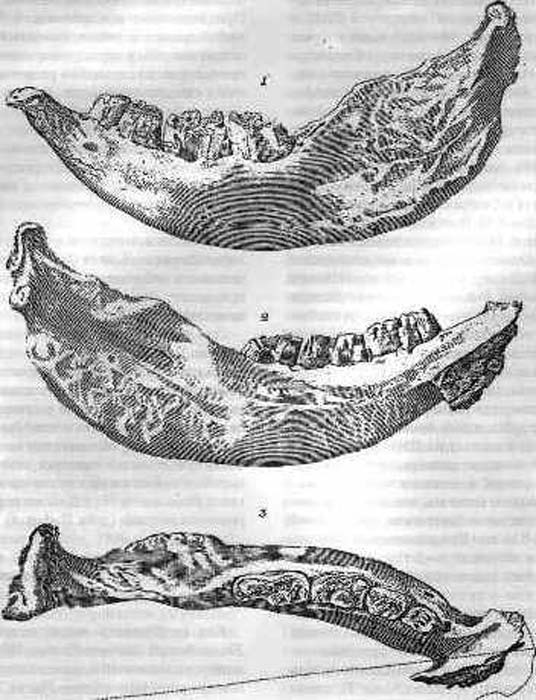
The "Moscow mandible", holotype of Elasmotherium sibiricum. ( Public Domain )
In March 2016, a beautifully preserved skull was plant in the Pavlodar region of Kazakhstan proving that the brute lived until the Pleistocene era, some 29,000 years agone, instead of the previously held conventionalities that they had died out 350,000 years ago. Based on the size and condition of the skull, information technology has been suggested that it was a very quondam male, but it is uncertain how the animal died.
- What Extraordinary Discovery Led to Unicorn Cave Magically Transforming into a Cash Moo-cow?
- Best Preserved Ice Age Woolly Rhino Discovered in Siberia
Diverse theories have arisen concerning the appearance of the Siberian unicorn, along with its nutrition and habits due to the wide variation in reconstructions. Some prove the brute galloping like a horse; others hunched over with caput to the ground, like a bison, and others immersed in a swamp like a hippo.
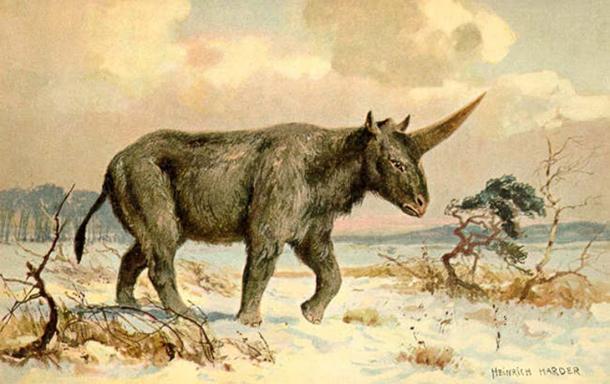
'Elasmotherium ' (circa 1920) past Heinrich Harder. ( Public Domain )
Debating the Siberian Unicorn'south Horn and Extinction
The result of the horn is highly debated, typically concerning whether in that location was one, or not, how large it was, and what information technology was used for. Theories on the role of the horn range from defense, attracting mates, driving away competitors, sweeping snow from the grass, and digging for water and plant roots. Since the beasts were herbivores, like our modern rhinos, this horn could not take been used to attack or kill prey.
Only circumstantial evidence exists from sparse specimens to prove whether the beast was horned or not, and whether it was hairy or baldheaded. Nevertheless, there is some show to propose that the brute was covered in pilus, like the more well-known woolly mammoth.
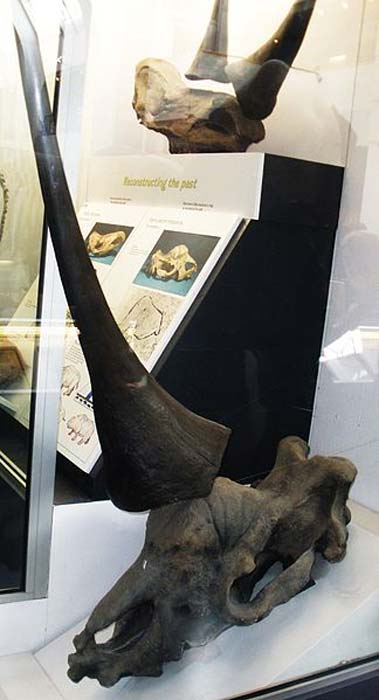
Fossil of Elasmotherium on display at the Natural History Museum, London. ( CC BY SA 3.0 )
The main evidence to propose that the Siberian unicorn was in fact horned is the frontal protuberance on the skull, which defenseless the attending of paleontologists in the 19th century and was immediately interpreted as the base of operations for a horn. Prove also shows that the horn would non accept been circular. This is supported by a fossil with a non-circular, partially healed puncture wound in the base, usually interpreted as the issue of dueling another male person with a horn.
While males would take fought for their territory, their habitat spanned from the Don River to the east of modernistic Kazakhstan. Remainder findings bear witness a long habitation of these ancient rhinos in the southeast of the West Siberian Plainly. Still, in that location is no clear reason why the final Siberian unicorns died out. Researchers accept been looking into the specific environmental factors that may take caused the extinction of this species, as information technology may lead to answers to the extinction facing various species today.

There is no clear reason why the final Siberian unicorns died out. ( Catmando /Adobe Stock)
The Legendary Unicorn
Legends of the unicorn, or a beast with a single horn, take been around for millennia in China and Eastern Europe. The Chinese "Thousand'i-lin", referring to some sort of brute, was translated into Turkish and Mongolic languages and lore. While the writers in all these languages did not know how to depict the beast, 1 common theme was the single horn, along with their vast stature.
A bronze vessel from the Warring States period shows an animal very much like 1 depicted in cave paintings that are said to be Elasmotherium: caput down for grazing, horn protruding from the forehead, and caput and shoulders slumped.
In 1866, Vasily Radlov found a legend among the Yakuts of Siberia of a "huge black bull" killed by a single spear. The creature was said to have a single horn so big that it had to be transported by sled. Other legends circulate in this region, usually concerning a large white or blue woolly bull with one large horn coming from its brow.
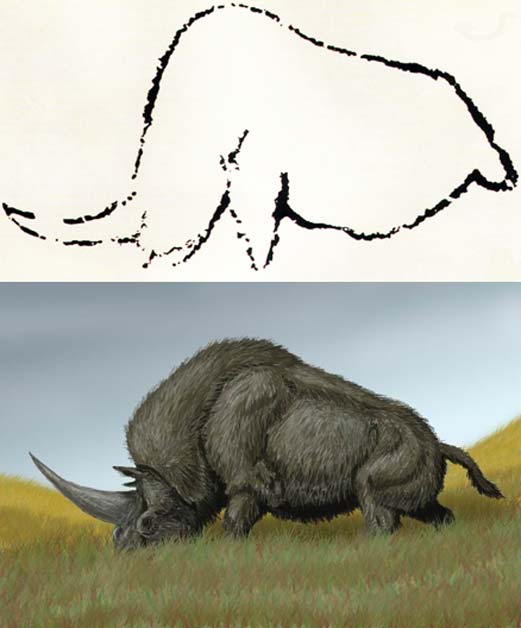
Top: Cave art from Rouffignac, France, idea to describe the extinct Elasmotherium. ( Public Domain ) Bottom: Elasmotherium sibiricum. (DiBgd/ CC By SA 3.0 )
From medieval Northern Russia comes a collection of ballads, called "Golubinaia kniga" or "The Book of the Dove," coming from Zoroastrianism, but with Christian overtones. These ballads show a righteous unicorn battling a king of beasts, representing lies. The unicorn of these tales lived on a Holy mountain, and information technology was believed to be the female parent and father of all animals. This fauna saved the world from drought by digging springs of pure and clean water with its horn. At night, it wandered the plains and forged a path with that very same horn.
- Is the Story of Christ Portrayed in the Unicorn Tapestries?
- Legends of the Unicorn Horn: Cures, Antidotes and Medicinal Magic
This same fauna appears in other religious texts, still, it is typically seen more every bit a symbolic creature rather than a real entity. The Arabo-Persian word for unicorn actually conflates unicorn and rhino, looking to the rhino as a bringer of truth and good in the world. In Christianity, the single horn is seen every bit a symbol of monotheism.
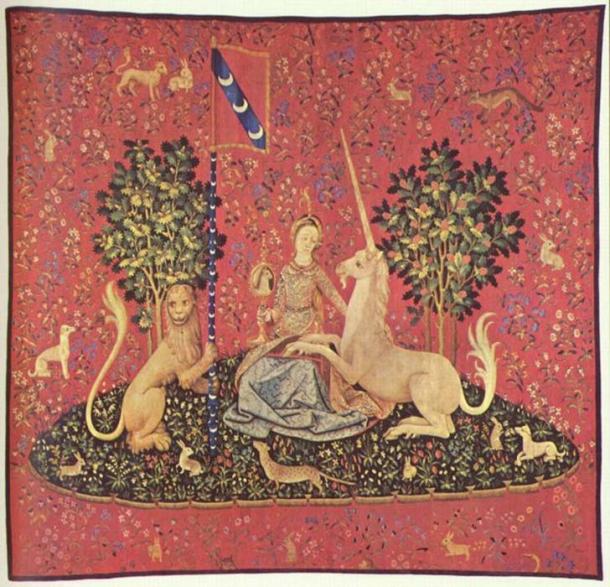
Maiden with Unicorn , tapestry, 15th century (Musée de Cluny, Paris). ( Public Domain )
While mythology may point to the actuality of this beast, information technology is merely circumstantial evidence. More research, and more fossils, must be establish before nosotros tin can know for certain what this beast looked like, and whether or non unicorns were real.
Tiptop Image: A reconstruction of what the Siberian unicorn may have looked like. Source: Elenarts /Adobe Stock
By Veronica Parkes
Updated on March 10, 2021.
Source: https://www.ancient-origins.net/unexplained-phenomena/last-siberian-unicorns-what-happened-mammoth-sized-one-horned-beasts-legend-021239
0 Response to "What Would a Unicorn and a Elephant Baby Look Like"
Kommentar veröffentlichen